The Gyro-X should never have existed. A two-wheeled gyroscopically stabilised car, like contemporary flying, magnetically levitating and nuclear-powered cars of the 1950s and 1960s, would not normally have made it beyond the pages of Mechanix Illustrated magazine.
This feature first appeared in Octane 259.
Its improbable leap from fantasy to reality was thanks to two uniquely talented individuals: a designer with a penchant for heroic failures, and a scientist with world-leading knowledge in gyroscopes. They met in 1960s California, as NASA launched the first Americans into space and Sharp landed the first microwave ovens on the shelves of Sears department stores. If ever there was a time and place that anything seemed possible, it was then and there.
Tom Summers had a flair for logic, physics, mathematics and mechanics. A textbook genius. He also had an aviation fetish, attaining a pilot’s licence before he graduated from high school. In early adulthood, he invented a gyroscopic air speed indicator that became the basis of the US Navy’s Norden Bombsight in World War Two. He continued in the same field post-war and established the Summers Gyroscope Company in 1946. When he stepped down 15 years later at the age of 51, the company had over 1500 employees and he had more than 30 patents to his name. In 1961, he formed the Summers Gyrocar Company in Northridge, California, to scratch his itch to develop gyroscopically stabilised vehicles. ‘Four wheels are ridiculous, three wheels are foolish, but two wheels are proper,’ he explained in 1975.
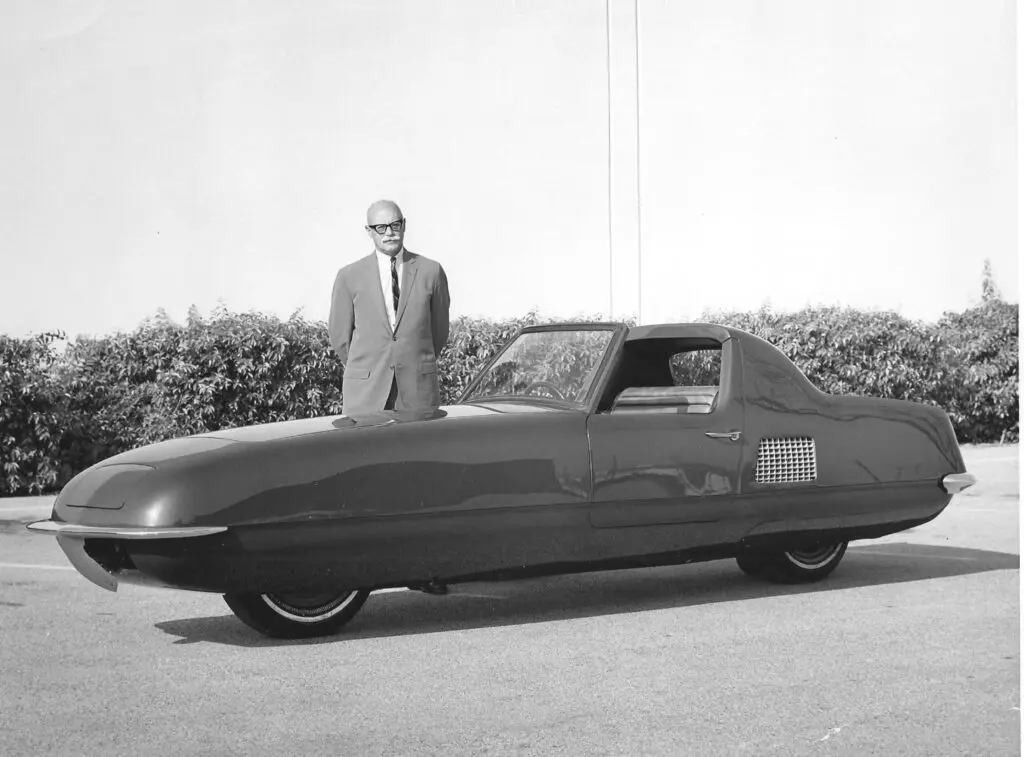
Alex Tremulis enjoyed pushing the envelope of car design and rarely let dreary practicalities or the laws of physics get in his way. He believed that cars should be aerodynamic, efficient and fast. He began his career fresh out of high school at Auburn-Cord-Duesenberg in 1933, rising to head of styling in 1937 (the trademark exhaust pipes that protruded from the bonnet of the supercharged Cord 812 were his doing). After A-C-D’s demise, he moved to the coachbuilder Briggs Manufacturing, under John Tjaarda, and penned the stylistically prescient Chrysler Thunderbolt and Newport concept cars, six each of which were built. He was drafted into the Air Force in 1941 and settled in what became known as the ‘Buck Rogers room’ at Wright Field airbase, Ohio. Here, he sketched characteristically far-fetched aircraft and imaginatively backwards-engineered German technologies from fragments of wreckage. Studying the gyroscopic guidance system of a V2 rocket kindled his interest in applying similar principles elsewhere.
Tremulis’s highest-profile project came in 1947, when Preston Tucker recruited him as chief stylist of the Tucker 48. While Tremulis was quick to credit the input of others, it was he that was largely responsible for the outlandish final design. A brief tenure as chief of advanced styling at Kaiser-Frazer led to another radical failure in the dashing form of the Kaiser 105, which would have had a glassfibre body, a flat-four engine and front-wheel drive. He assumed the same job title at Ford in 1952. A surprisingly free remit allowed him to indulge his interest in gyroscopic stabilisation.
‘Alex bought a toy gyroscope at an Army-Navy surplus store and tied it to a bar with two tandem wheels,’ recalled co-worker Bob Thomas in 2008. ‘He’d power up the gyroscope with the studio air-lines, give the thing a push and it would go straight as an arrow to the opposite wall and crash.’ His experiments culminated in the Ford Gyron concept car unveiled at the 1961 Detroit Auto Show, a two-wheeled two-seater with styling that resembled the flying car from The Jetsons.
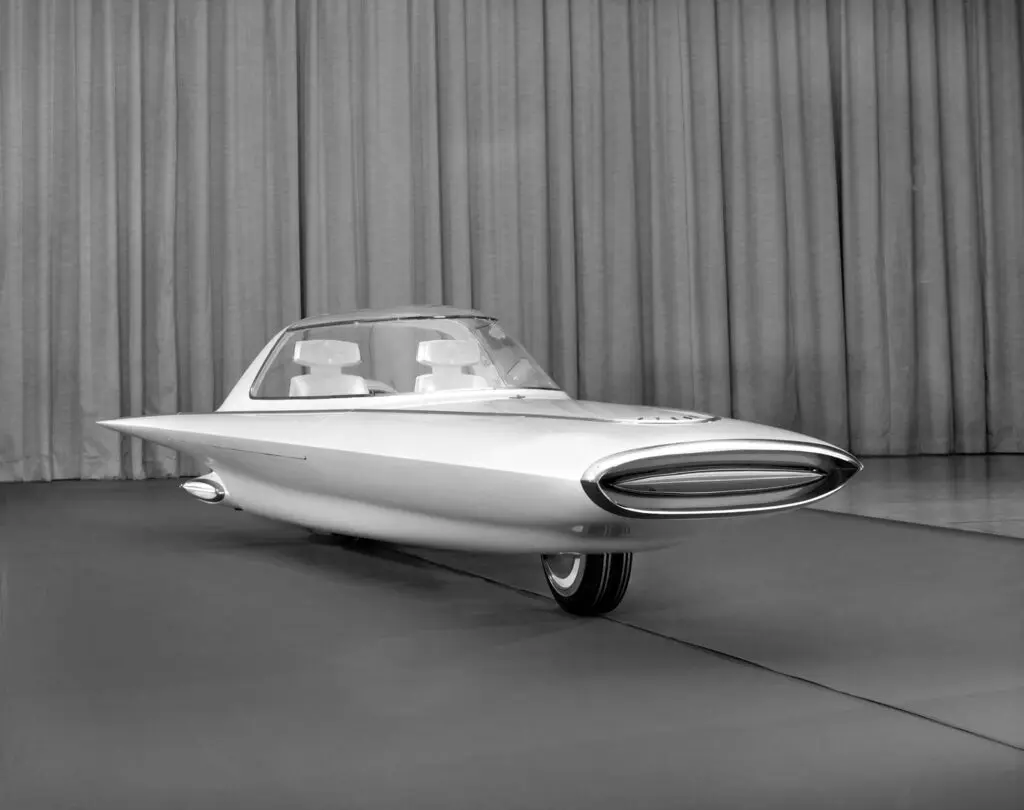
‘I believe that historians will one day write that the gyro contributed more to land transportation than it did to sea and space travel,’ Tremulis proclaimed. Ford’s management was unconvinced and baulked at the projected cost of $135,000 to develop a working gyroscope. Tremulis left in 1963 and set up his own automotive consulting firm.
Summers and Tremulis met in 1966. The Summers Gyrocar Company had already fulfilled a contract with the US Department of Agriculture for five small two-wheeled ‘mules’ to carry loads slowly up mountain tracks. These performed satisfactorily, though no further orders were placed. Summers had begun raising the necessary capital for his magnum opus: a gyrocar capable of mixing with modern traffic. Tremulis reached for his pencils…
A gyrocar was nothing new – but a gyrocar that worked would be. The 1912 Schilovsky gyrocar was a steampunk contraption built by Wolseley in the UK for Russian Count Pyotr Schilovsky. Balanced like a spinning-top by a single horizontal flywheel, it was capable of remaining upright while passengers hopped on and off, but it became easily upset at speeds above walking pace and turning corners proved problematic. Also in the UK, Irish-Australian engineer Louis Brennan demonstrated a monorail balanced by a pair of vertical flywheels in 1909 and applied the same concept to a two-wheeled car in 1929. How well it functioned is unclear, but it failed to win backing from any of the car manufacturers to whom it was touted.
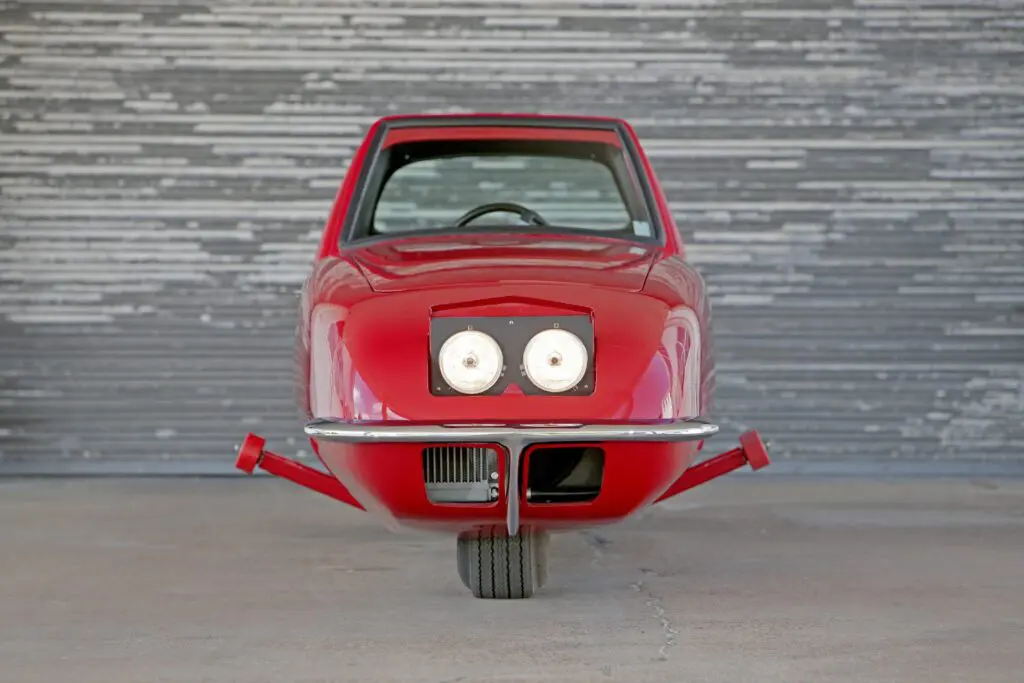
The Gyro-X, like Summers’ ‘mules’, used a single gyroscope consisting of a vertical flywheel in a spherical housing mounted behind the front wheel. The flywheel was a robust 113kg in weight and 508mm in diameter. It was aligned with the front wheel but rotated at a constant speed in the opposite direction (relative to the front wheel when the car was moving forwards). It could be turned left and right – again like the front wheel – inside its housing by a hydraulic ram. Turning a spinning flywheel (or ‘gyroscopic precession’, to use the correct term) creates a resultant force at 90o to its plane of rotation. Thus, steering the Gyro-X’s flywheel to the left caused the car to lean to the left, and vice versa. With the addition of a tilt sensor and a control system that made constant split-second adjustments to gyroscopic precession – like a tightrope walker does with a weighted pole – the car could be made to stand upright. With the additional inputs of speed and steering wheel position, the system could make the car lean into corners, as a motorcycle rider does by throwing their body-weight around.
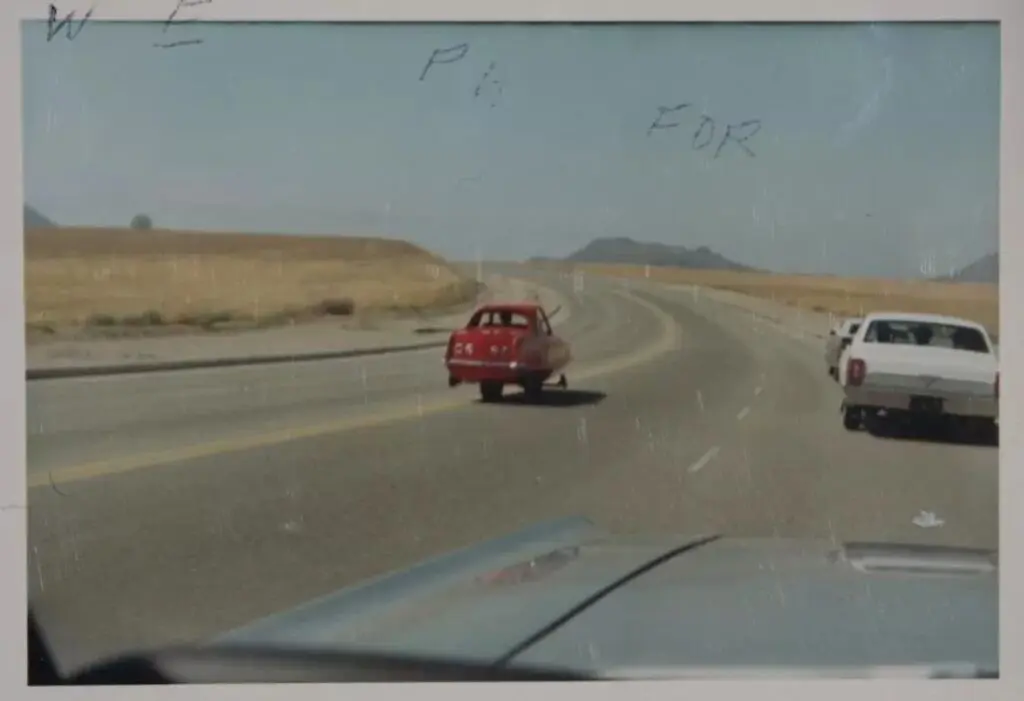
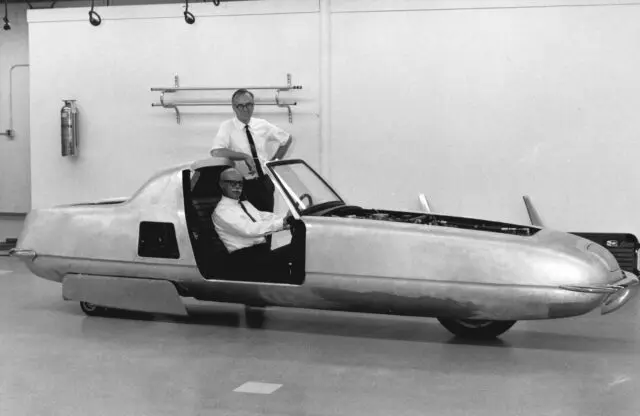
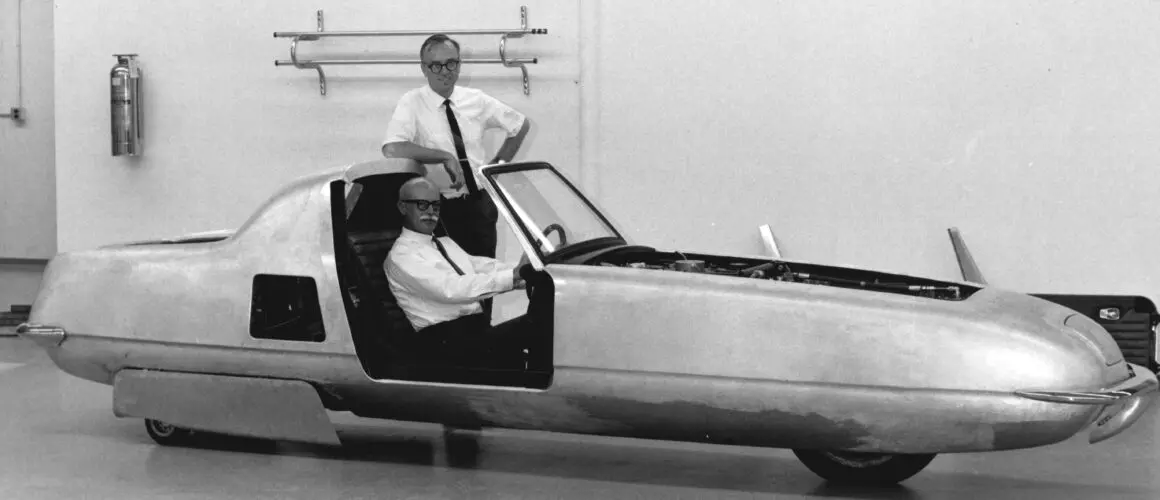
‘An aerodynamically sleek two-wheeled sports car that tracks die-straight down the most slippery of highways, manages 125mph from a tiny 80hp engine, can’t skid or flip and literally flies around 40o embankments like an airplane…’ This is just a taste of the hot air that surrounded the Gyro-X’s unveiling at the New York International Auto Show on 1 April 1967. In reality, the prototype could do none of these things. It was, nonetheless, spectacular. Tremulis’s torpedo body dragged the Ford Gyron concept towards the 1970s, with crisp and unadorned lines, a jet-age pop-up headlight and a quartet of afterburner taillights from a Chevrolet Corvair. Its tubular spaceframe and all-aluminium body had been hand-built to impeccable standards by famed Los Angeles coachbuilder Troutman-Barnes, where it was painted cherry red by custom car artisan Hershel ‘Junior’ Conway. Summers described the cabin as large enough for two occupants to sit side-by-side in ‘tolerable comfort’. The passenger would have had to be intimately acquainted with the driver and, in the prototype, happy to take charge of the left-mounted clutch pedal.
Air-cooled flat-four and flat-six Volkswagen and Corvair engines were mooted for the production versions, driving the gyroscope and the rear wheel hydraulically: in effect, an automatic transmission. It would also have allowed the gyroscope to be used to store kinetic energy, spooling up under deceleration and feeding energy back into the drive system under acceleration. The prototype had to make do with a BMC A-series engine, albeit in its raciest 76bhp Mini Cooper S form. Two hydraulic pumps powered the gyroscope and its control system, but drive was delivered to the wheel via a chain and a four-speed Mini transmission with its differential locked.
Whether the prototype functioned with any degree of adequacy is doubtful. ‘We had stabilisation problems in high-speed cornering that were never resolved,’ reminisced Summers Gyrocar Company employee Robert Poteet in 2018. Period video footage, often slyly speeded up, never showed the car moving much above walking pace. Press shots that claimed to demonstrate it running on public roads all featured the same cars posing as traffic – and all giving it a conspicuously wide berth. It had its gyroscopic control system removed on the occasions that it was shown to the motoring press, supposedly because the US military had expressed an interest and wished it to remain classified, but more likely because it ruled out practical demonstrations that the journalists might have found unimpressive.
Further Gyro-X prototypes never appeared and press excitement gradually fizzled out. The original car made it onto the road in Summers’ hands in the mid-1970s, but it had acquired a second rear wheel and a Volkswagen Beetle drivetrain. Summers continued to toy with concepts for gyroscopically stabilised vehicles for many years, but never saw another project realised. Tremulis resumed his quixotic career, designing the Subaru BRAT pick-up, styling a 413mph rocket car, developing a gyroscopic monorail for the Lyndon B Johnson administration, and setting a land speed record for motorhomes at Bonneville in an Oldsmobile Toronado-powered behemoth of his own construction (97.6mph, now surpassed, though not by a significant margin).
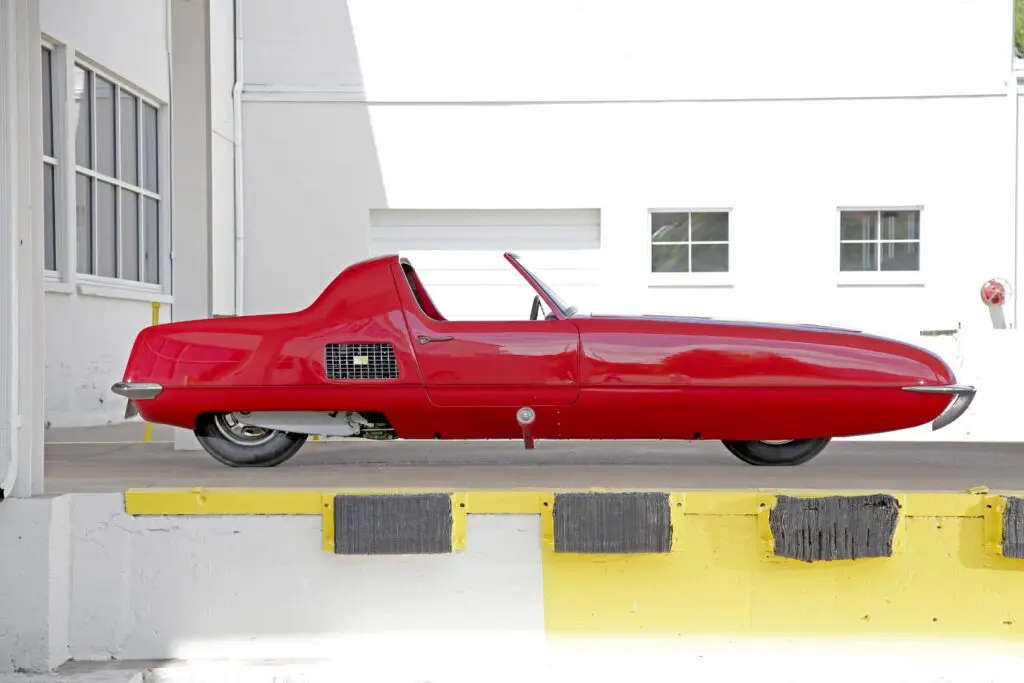
There was more to come for the Gyro-X, however, thanks to a second pair of uniquely talented individuals: Lane Motor Museum founder Jeff Lane and master restorer Michael Hüby. The car surfaced on YouTube in 2004 in the ownership of a Las Vegas entertainer named John Windsor, who’d acquired it in settlement of a debt. It was still a Volkswagen-powered three-wheeler, but it had been much hacked-around. It had also been denuded of its gyroscope and various other key components. Windsor sold it to eclectic car collector Mark Brinker in 2009, who, after a long courtship, sold it to Jeff Lane in 2011.
‘We wanted to return the Gyro-X as closely as possible to what it was in 1967, rather than reimagining it and ending up with a car that it never was,’ says Lane. ‘We were lucky that Alex Tremulis’s nephew, Steve Tremulis, was able to supply a large quantity of photos from his archive.’ Hüby used these as his guide as he worked his way through the car from tip to tail, restoring parts that were originally there, removing parts that were not, and replacing parts that had gone missing. A lot fell into the latter category.
Hüby went to great lengths to source correct off-the-shelf components: a Halibrand Sprint rear wheel, Hurst Airheart brake calipers, Koni dampers and, of course, a Mini Cooper S engine and transmission. What he couldn’t buy, he fabricated. ‘I ended up making almost everything needed to make it drive,’ says Hüby. ‘I fabricated the chain drive, the shifter mechanism, the rear swing-arm, the front suspension, the braking system, much of the cable steering system and so many bits-and-pieces. I used Steve Tremulis’s photos to work out dimensions. For example, I could tell that the rear brake used a Hurst Airheart four-piston caliper. I knew that the distance between the caliper’s mounting screws was 5.25in, so from the photo I could extrapolate the size of the swing-arm, the diameter of the hub bearing and so on.’
Hüby used 3D modelling software and a 3D printer to design bespoke components, which could then be sent off for CNC machining. These included the front wheel, the front hub assembly and the gearbox that delivered drive to the hydraulic pumps. ‘The original wheel and hub were cast aluminium and had only a fraction of the required strength,’ he observes. ‘The hub also had no caster angle, so the car could never have been very good at driving in a straight line.’
Building the gyroscope was delegated to Agency Impianti in Pisa, Italy, a world leader in active gyroscopic stabilisation systems for large yachts. The completed instrument was slightly smaller than the original, with a flywheel 104kg in weight and 434mm in diameter. ‘It still has a huge amount of kinetic energy,’ says Lane. ‘At 3000rpm it has as much potential energy as a 900kg car travelling at 30mph – and it keeps spinning for two hours after you turn it off.’ Developing the computerised control system became a labour of love for Hüby and Agency Impianti founder Stefano De Simoni. ‘We’re now running version 129 of the control software,’ reports Hüby. ‘I don’t see how Tremulis and Summers could ever have got it working well with only analogue control.’
The Gyro-X’s body was in good enough shape to restore, but the interior had to be built from scratch. The six-year restoration was completed just in time for a public debut at the 2017 Pebble Beach Concours d’Elegance, where it was a worthy winner of the Dean Batchelor Trophy for ‘the most significant car related to our hot rod heritage’.
So… what’s it like to drive? The cabin’s lack of ergonomics betrays the car’s prototype status. The gyroscope housing is directly in front of you, with the clutch pedal on the left, the brake on the right. The accelerator, awkwardly, is in front of the brake, which makes moving your foot between them a gymnastic exercise. The right-handed gearchange has a backwards gate, with first to the right and back, second to the right and forward, and so on.
Starting it feels like starting a spaceship. Pull out the choke, turn the key, ease the choke in as it warms up and adjust the thumbscrew on the accelerator pedal to achieve a steady 2000rpm idle. Flip the power switch to turn on the control system, then another to power up the gyroscope. Wait for the gyroscope to reach its operating speed of 3000rpm, for the hydraulic motor pressure to drop to around 400psi and for the hydraulic oil temperature to reach 50°C, which takes around five minutes unless it’s a cold day. Ensure the control system is in ‘park’ mode and push up the toggle switch to raise the parking wheels until the light on the dashboard turns green. The cacophony that accompanies this is suitably otherworldly, the thrashing of the A-series competing for prominence with the drone of the hydraulic pumps and the whine of the gyroscope.
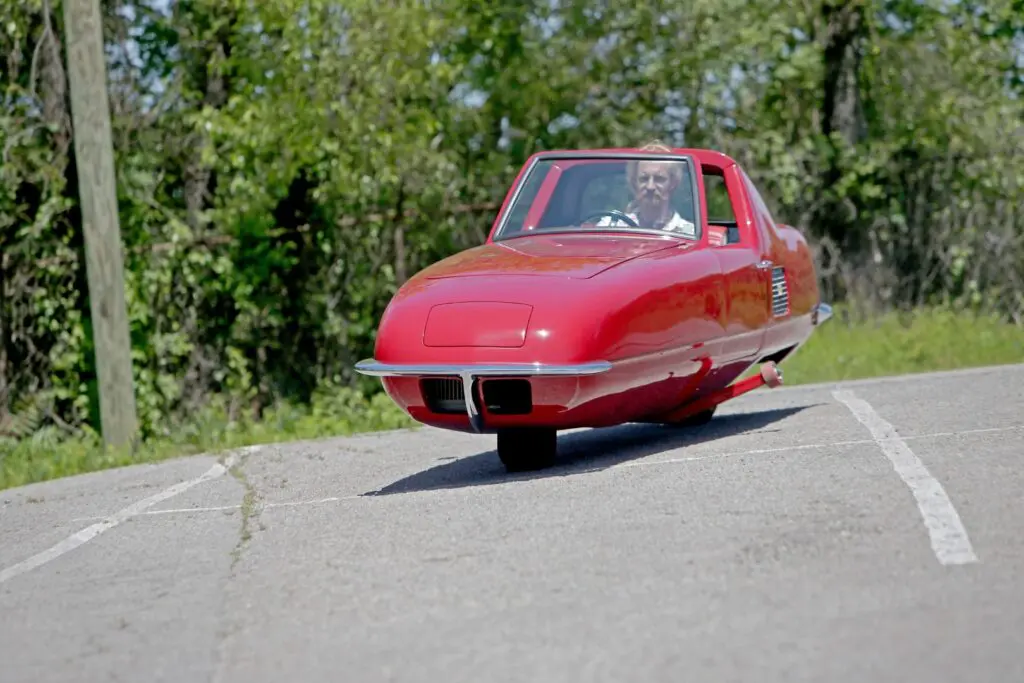
You can now engage first gear, switch the control system to ‘drive’ mode and pull away. And it feels every bit as weird as you’d expect. The gyroscope saps little of the engine’s power once it’s up to speed, so acceleration is as swift as the driver is brave. On the rare occasions that everything goes smoothly, it really works: it tracks straight while remaining bolt-upright and leans itself smoothly into corners. Most of the time, though, extraneous forces interfere with the extremely sensitive control system. Gusts of wind, undulations, potholes and any form of sudden input from the driver lead to twitches, lurches and wobbles. Sneeze and the car sneezes with you. The momentum of the gyroscope can be felt through the steering wheel.
At its best, the car practically steers itself round corners with the lightest of driver input. At its worst, it fights back, tugging at the wheel as it yanks itself upright or teeters perilously in the wrong direction. Occasionally, it becomes unsettled for no apparent reason, which is partially linked to the digital sensors operating at a similar frequency to the vibrations generated by the A-series engine.
Hüby has mastered the Gyro-X to a greater degree than anyone else. He’s braved Nashville’s traffic and achieved 55mph on a private track. ‘We figure this is as good as it gets without throwing more time and money at it,’ he says. I ask if, with modern technology and the wealth of knowledge he’s accumulated, it would be possible to reengineer the car to function as Summers and Tremulis intended. ‘Probably not,’ he replies. ‘The laws of physics would still apply. But with today’s materials and computing capabilities, it would be possible to make it much better. An all-electric, carbonfibre-framed version would solve the problems of vibration, weight, torsional stiffness and energy recovery.’
Nonetheless, Hüby believes that the Gyro-X should not be considered a failure: ‘As with every futuristic concept, there are visions that can’t be turned into reality at the time they are conceived, but once they are put out there, the hive mind of science starts thinking about them and eventually you end up with partial realisations. Look at Arthur C Clarke’s novel Imperial Earth, in which he basically described a modern smartphone in 1975. Just like that, the regenerative braking, dynamic stability control and aerodynamics that were all part of the Gyro-X concept have now found their way into modern cars.’
It’s a shame, however, that the future we live in is nowhere near as cool as the one that Tremulis envisioned.